
The Desert
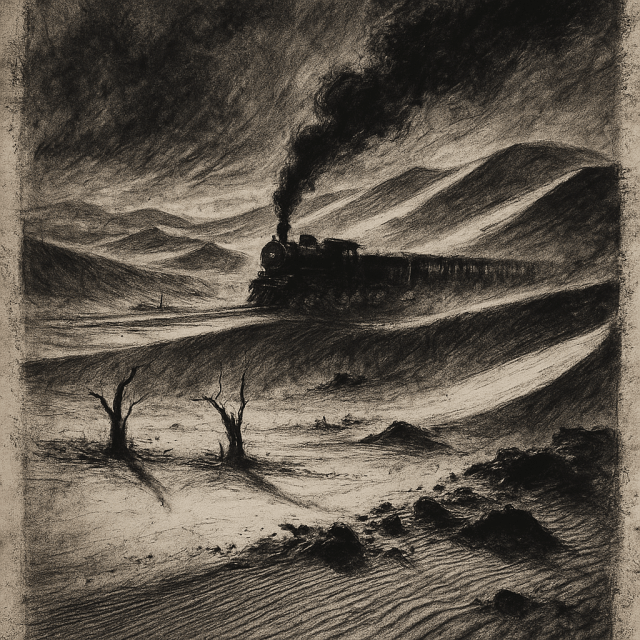
The sea of sand stretched as far as the eye could see, each dune sculpted by the hot desert winds. It seemed to capture the disordered whirlwinds of the master of chaos’s mind. He advanced beneath a crushing sun, leaving footprints that vanished almost instantly, as though the desert refused to preserve the slightest trace of his passage.
His thoughts were confused, his essence torn between reality and increasingly troubling visions. He perceived floating forms at the edges of his consciousness, sometimes turning into familiar places: the ruins of a temple, a woman whispering his name, or eyeless beings staring at him intently. A person strapped to a metal chair…
— They are only residues, he thought. Yet another part of him sensed it was more complex. His visions were not mere hallucinations — they seemed more like muddled echoes he struggled to grasp and situate in time.
When he boarded the train, he hoped the steady rocking would calm his tormented mind. Unfortunately, the journey only heightened his unrest.
The landscapes flashing past the window seemed to warp, merging with his memories and visions. Sometimes the taiga trees turned into motionless human figures, and the frozen lakes reflected a sky of deep black, strewn with mysterious stars. He heard murmurs in the clatter of the wheels on the rails — echoes of his past blending into the noise.
Seated in an empty compartment, he studied his reflection in the glass. Yet what he saw was not his human face, but the flickering, enigmatic glow of his deeper self.
— Is it you, or a version of you? whispered a voice in his mind.
He averted his gaze, but the voice persisted, woven with a distant melody. He could not identify it, but it obsessed him.
When the train reached the Aral Sea and stopped for technical reasons at an abandoned station, Amano briefly stepped out of the compartment. What he discovered exceeded all his expectations.
The seabed, once vast and teeming with life, had become a barren plain. Rusting shipwrecks littered the cracked sand, mournful remnants of an ecological tragedy. The air was suffocating, saturated with toxic particles and salt.
He stopped before one of the wrecks, placing his hand on the oxidized metal. Images assailed him — memories of a time when the sea had still existed. He felt the suffering of destroyed ecosystems, the despair of fishermen who had lost everything, and the fury of a nature betrayed by humanity.
— You don’t need me to sow chaos! he exclaimed, with a mix of contempt and sorrow.
The visions grew sharper. The ground beneath his feet began to crack, and shadows rose from the fissures, taking the shapes of dying aquatic creatures. Their wails echoed in his mind, deepening his inner turmoil.
He stepped back, but the landscape seemed to close in around him, as if he were being pulled into a whirlpool of images and sensations. The Aral Sea, in its destruction, had become a reflection of his own state: once glorious, now reduced to an empty shell.
As Amano resumed his journey, his thoughts drifted. Each step he took, each vision that struck him, revealed a deeper truth. Humanity did not need demons like him to be condemned. The chaos it created was enough to destroy it. But one question surfaced in his mind: what if that chaos could become a tool for rebirth?
Amatsu was the lord of primordial chaos. He was the sworn enemy of order and matter. He walked among a humanity that, in his eyes, was both lost and resilient. As he became more human, he understood that he was not the feared detonator, but rather the sower of a future for his kind. It was like a silent symphony, played throughout his journey.l silhouette cut out against the pitiless glare of the neon.
 Un Long Voyage